Back
Back
 Venda más vehículos
Integre fácilmente herramientas inteligentes diseñadas para maximizar la conversión de clientes potenciales.
Transforme los datos de sus clientes en información valiosa
Obtenga una mayor visibilidad y control sobre sus datos.
Reduzca los costes operativos
Optimice procesos y automatice flujos de trabajo para mejorar la eficiencia.
Permita experiencias automotrices en múltiples mercados
Ofrezca experiencias digitales coherentes en diferentes regiones y redes de concesionarios.
Ofrezca experiencias de marca y cliente coherentes
Estandarice los recorridos de sus clientes dentro de un único sistem
Convierta el interés de los clientes en ventas
Reduzca las fricciones mediante métodos de pago flexibles, aprobaciones instantáneas y un procesamiento seguro.
Aumente el volumen de solicitudes
Reciba mejores datos. Apruebe más solicitudes. Dedique menos tiempo a las tareas manuales.
Amplíe su alcance
Configure, implemente y promocione fácilmente campañas de financiación en canales digitales.
Reduzca los costes de adquisición
Implemente comprobaciones de elegibilidad para reducir los costes de evaluación de riesgos y simplificar las solicitudes.
Más entidades financieras. Más aprobaciones.
Acceda a la cobertura más amplia de entidades financieras desde una única plataforma.
La opción preferida por los concesionarios
Con la confianza de más de 400 concesionarios oficiales, ofreciendo una única conexión para todos los puntos de contacto con el cliente.
Back
Storefront
Optimice los procesos y automatice los flujos de trabajo para reducir los costes operativos y mejorar la eficiencia.
Checkout
Simplifique la financiación, los pagos y las reservas en una única plataforma.
Point of Sale
Gestione todo el flujo de trabajo de financiación desde un único sistema centralizado.
CommerceHub
Impulse todo el recorrido de compra de vehículos a través de nuestra aplicación de gestión administrativa.
Vehicle Manager
Mejore el rendimiento de su inventario, supervise el stock y publique anuncios fácilmente en plataformas de terceros.
Suite de API
Potencie su oferta digital mediante integraciones con la arquitectura existente de su sitio web.
Venda más vehículos
Integre fácilmente herramientas inteligentes diseñadas para maximizar la conversión de clientes potenciales.
Transforme los datos de sus clientes en información valiosa
Obtenga una mayor visibilidad y control sobre sus datos.
Reduzca los costes operativos
Optimice procesos y automatice flujos de trabajo para mejorar la eficiencia.
Permita experiencias automotrices en múltiples mercados
Ofrezca experiencias digitales coherentes en diferentes regiones y redes de concesionarios.
Ofrezca experiencias de marca y cliente coherentes
Estandarice los recorridos de sus clientes dentro de un único sistem
Convierta el interés de los clientes en ventas
Reduzca las fricciones mediante métodos de pago flexibles, aprobaciones instantáneas y un procesamiento seguro.
Aumente el volumen de solicitudes
Reciba mejores datos. Apruebe más solicitudes. Dedique menos tiempo a las tareas manuales.
Amplíe su alcance
Configure, implemente y promocione fácilmente campañas de financiación en canales digitales.
Reduzca los costes de adquisición
Implemente comprobaciones de elegibilidad para reducir los costes de evaluación de riesgos y simplificar las solicitudes.
Más entidades financieras. Más aprobaciones.
Acceda a la cobertura más amplia de entidades financieras desde una única plataforma.
La opción preferida por los concesionarios
Con la confianza de más de 400 concesionarios oficiales, ofreciendo una única conexión para todos los puntos de contacto con el cliente.
Back
Storefront
Optimice los procesos y automatice los flujos de trabajo para reducir los costes operativos y mejorar la eficiencia.
Checkout
Simplifique la financiación, los pagos y las reservas en una única plataforma.
Point of Sale
Gestione todo el flujo de trabajo de financiación desde un único sistema centralizado.
CommerceHub
Impulse todo el recorrido de compra de vehículos a través de nuestra aplicación de gestión administrativa.
Vehicle Manager
Mejore el rendimiento de su inventario, supervise el stock y publique anuncios fácilmente en plataformas de terceros.
Suite de API
Potencie su oferta digital mediante integraciones con la arquitectura existente de su sitio web.
Attitudes to car finance and omnichannel car buying across the UK, Germany, France, Spain and Italy.
Written by Danielle Harrod
Last edited 30/07/2026
Share
Car buying trends across Europe in 2026 show clear differences in how consumers approach car finance, affordability and omnichannel buying journeys. Data shows that financial confidence, trust in providers, digital adoption and affordability all shape how consumers engage with car finance and move through the automotive purchase journey.
Drawing on a survey of 5,000 car buyers across the UK, Germany, France, Spain and Italy, this Codeweavers report explores how consumers fund and purchase vehicles. This includes the role finance plays in that journey, how they research their options, and where friction, trust gaps and unmet expectations may limit conversion.
The UK stands out as one of the most financially confident and digitally engaged markets surveyed. However, confidence doesn’t directly translate into higher car finance usage. Instead, trust, transparency and affordability consistently shape consumer decision-making, impacting how OEMs, retailers and lenders present finance, deploy digital tools and build trust, both online and in the dealership.
Across all five markets, consumers value omnichannel car buying, but the way those connected buying journeys are structured varies by market. Some consumers expect digital tools to support research, comparison and affordability checks, while others are more reliant on dealership or in-person guidance.
For OEMs, finance providers and UK retailers, the opportunity lies in building connected finance and retail journeys that reflect how consumers actually research, compare and commit to vehicle purchases.
This report is designed to support automotive retail and finance strategy in 2026 and beyond by answering two critical questions:
1. How are UK consumers approaching car finance and vehicle acquisition in 2026?
Examining car ownership models, finance usage, product awareness and the evolving automotive customer journey, this report identifies where confidence is strong, fragile and where opportunities exist to improve conversion within the domestic market.
2. How does UK car buying behaviour compare to Europe?
By analysing the same behaviours across Germany, France, Spain and Italy, it’s clear where consumer expectations align and where meaningful differences require a localised strategy.
For OEMs and finance providers this report provides a pan-European view of consumer behaviour, highlighting where standardised finance and digital retail strategies may fall short. It identifies where localisation is required, particularly in areas such as finance presentation, trust building and digital maturity, and where opportunities exist to influence consumers earlier in the buying journey.
For UK dealers it offers insight into how consumers are currently researching, funding and purchasing vehicles. Including where they remain hesitant, what matters most to them in the automotive buying journey, and where gaps in confidence, transparency and affordability understanding create opportunities to improve conversion.
Many consumers evaluate vehicles based on monthly affordability, while still expecting full transparency on total cost of ownership.
In 2026, UK car buyer trends and the automotive customer journey are shaped by financial confidence, digital engagement and well-established omnichannel buying behaviour. UK consumers are more comfortable researching vehicles online, comparing finance products digitally and moving between online and in-dealership steps than any other market surveyed.
However, strong confidence does not automatically translate into higher finance conversion. Despite substantial awareness of and openness to available finance products, concerns around transparency, trust and affordability visibility create friction throughout the UK automotive customer journey.
This section examines how UK consumers acquire vehicles, engage with car finance, assess affordability and move through the buying journey, highlighting where expectations are strongest and where friction creates commercial opportunity.
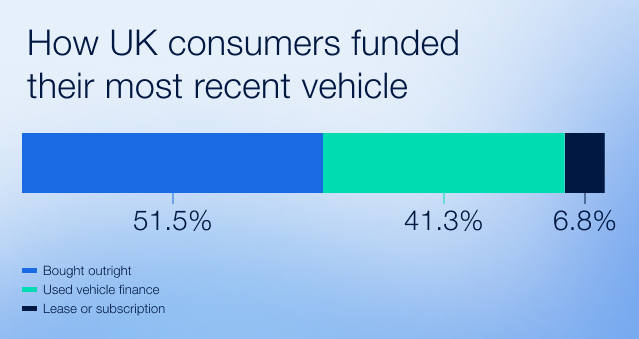
Car ownership data in the UK is primarily driven by outright purchase, with 51.5% of respondents paying in full for their most recent vehicle, compared with 41.3% using car finance and 6.8% leasing.
However, the picture of finance familiarity is more substantial than recent purchase behaviour alone suggests. When past behaviour is considered, 52.2% of UK respondents have used car finance or leasing at some point, showing that finance is a mainstream part of the automotive purchase journey in the UK. Car finance is therefore both widely understood and frequently used, even among consumers who chose to pay in full for their most recent vehicle purchase.
It is worth noting that the UK vehicle market is heavily weighted towards used vehicle transactions. FCA analysis shows that while motor finance accounts for more than 80% of private new car sales, it represents 19% of used car sales, helping explain why outright purchase remains common despite the widespread use and familiarity of vehicle finance.
While 41.3% of UK respondents used finance for their most recent vehicle, more than two thirds (67.6%) say they are open to using it in the future. This creates a clear gap between consideration and usage, which becomes important when assessing the role of trust, transparency and affordability later in this section.
Looking at how UK respondents research and buy vehicles, their car purchasing behaviours combine high levels of digital engagement with continued use of in-person dealerships.
Across all digital channels measured, UK consumers show the highest levels of engagement of any market surveyed, while in-person dealership visits remained the most common individual research method.
When researching their most recent vehicle:
This behaviour reflects mature omnichannel car buying behaviour, where online research and finance exploration support, rather than replace the role of dealerships.
UK respondents also expect these digital and in-person stages to feel connected, particularly when it comes to pricing consistency, channel switching and finance continuity.
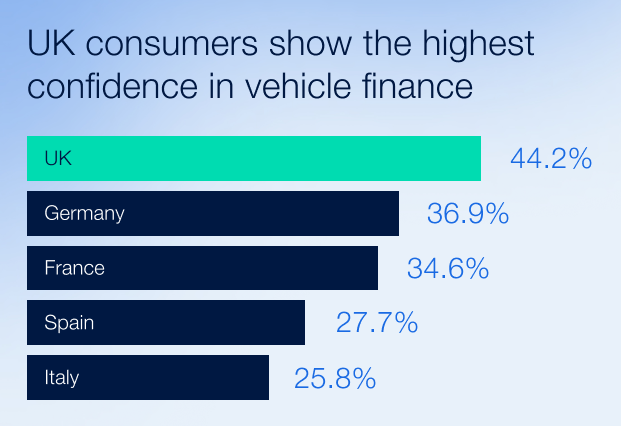
When asked what would be the most valuable during the research and buying process, UK respondents consistently prioritised connected retail experiences, pricing transparency and clear affordability visibility:
Together, the findings show UK consumers expect digital research, finance exploration and dealership interaction to operate as part of one connected buying experience.
However, friction remains throughout the process.
Nearly two in five (38.8%) cite too many options as their biggest challenge, while 28.4% struggle with unclear total cost information and 21.6% find it difficult to compare finance options.
Notably, these challenges are not just usability issues. They shape how consumers perceive transparency, trust and confidence within the wider car buying process.
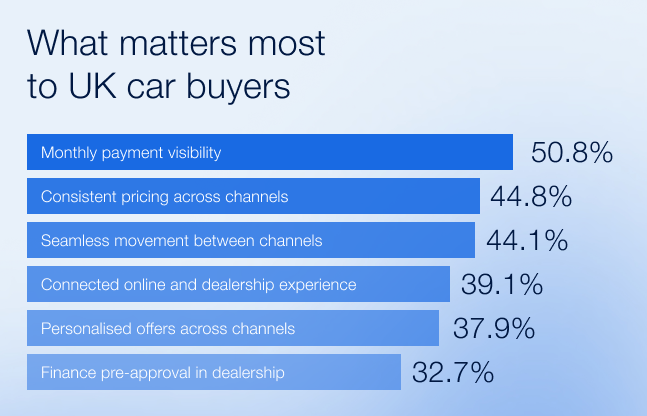
UK respondents recorded the highest levels of finance confidence and product awareness across all markets surveyed. Overall, 93.2% said they understand car finance, while 44.2% described themselves as very confident in their understanding.
Awareness across all major finance products also exceeded 91%, higher than any other market. This demonstrates that confidence and awareness don’t automatically translate into widespread finance usage. Instead, as the next section suggests, it potentially raises expectations around transparency, simplicity and trust throughout the finance journey.
When asked what matters most when purchasing a vehicle, UK respondents placed trust and transparency above all other considerations. 94.3% say reputation and trustworthiness of the dealer or finance provider is important to them, while 89% prioritise transparency and clarity of finance terms.
Despite this, many UK respondents still experienced transparency and process-related frustrations throughout the finance journey.
Key UK car finance frustrations:
Operational and administrative steps were also cited as barriers. Just under one in three (31.6%) respondents said too much paperwork or administration creates frustration, while 20.7% dislike repeating information across channels, and 17.5% experienced slow approval processes.
Trust within the UK car finance market then, is shaped by provider reputation and how clearly, consistently and seamlessly the finance journey is presented.
While UK respondents show mature levels of financial confidence overall, that confidence is distributed differently across individual finance products.
Dealer and retailer-arranged finance recorded the biggest appeal at 65.1%, suggesting consumers value the convenience of organising finance through the point of sale. However, as dealer or retailer finance is often delivered through products such as PCP or Hire Purchase, this finding may also highlight some confusion between where finance is arranged and the type of agreement being used. PCP was the next most appealing finance product at 61.4%, ahead of Hire Purchase at 59.2% and bank or personal loans at 57.2%, while leasing generated the lowest appeal at 50.2%.
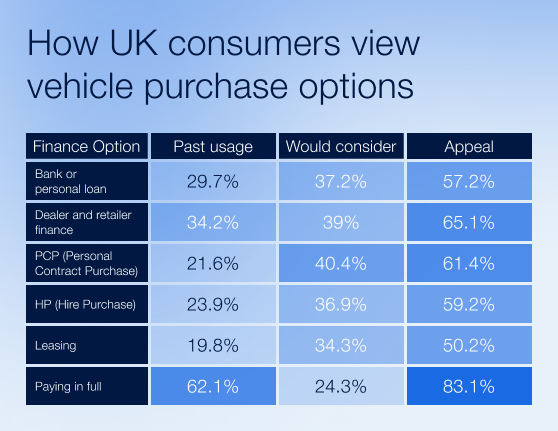
The contrast between PCP and leasing is particularly revealing. Both involve monthly payments, but PCP provides the option of ownership at the end of an agreement and leasing does not. This distinction between ownership appears to have commercial implications, further reinforced by leasing holding the highest avoidance rate of any finance product. Two in five respondents (39.3%) said they would actively avoid it, compared to 29.1% of PCP.
Future consideration data supports this trend, with PCP recording the strongest future interest at 40.4%, ahead of dealer or retailer finance (39%), bank or personal loans (37.2%) and Hire Purchase (36.9%).
Notably, paying in full, despite being the most appealing payment method overall at 83.1%, shows comparatively low future consideration at 24.3%. This reflects a UK market where outright ownership remains aspirational for many, yet finance is likely the more realistic or practical purchasing route.
Overall, UK consumer car finance behaviour appears to be shaped less by resistance to finance and more by a desire for clarity, choice and a clear route to ownership. While paying in full remains the most common past behaviour, the spread of future appeal across different finance and funding options suggests UK consumers are becoming more considered in how they assess the market.
UK car finance provider preferences
When considering finance providers, UK respondents showed clear preferences. More than one in three (36.5%) said they’d look to retail banks first, ahead of automotive finance brands at 15.3%. This highlights that UK consumers still compare bank loans against dealer-arranged finance options early in the journey. Consumer finance providers followed at 8.2%, while only 5.7% selected dealerships or online platforms.
The gap between retail banks and automotive finance brands is strategically significant for OEMs and finance providers. Many UK respondents default towards established banking relationships before considering automotive finance providers, suggesting familiarity is a major influence during early finance consideration.
Looking at the wider findings, however, dealerships continue to play an influential role once consumers move further into the finance journey. Dealer and retailer finance products recorded the most significant appeal among finance options at 65.1%, while dealer-arranged finance also represented the most used finance route (30.1%) among those who financed their most recent vehicle.
Overall, the findings suggest UK consumers may begin the finance process with retail banks in mind, while still relying heavily on dealerships during finance comparison and arrangement stages.
The online finance journey: Trust, behaviour and concerns
Looking specifically at how car finance is arranged, UK respondents demonstrate considerable openness towards digital finance experiences, particularly during the early stages of the journey.
Appetite for digital finance is clear. Three in five (60.4%) reacted positively to the idea of arranging finance entirely online, the highest proportion of any market surveyed. Similarly, two thirds (66.6%) say they would likely adopt a fully online finance process that combined vehicle browsing, purchasing and lender comparison all in one platform.
Preferences around digital finance varies significantly depending on the stage of the journey. Respondents are most comfortable completing research, affordability and comparison tasks online, while final commitment leans heavily towards in-person engagement.
UK respondents are most comfortable completing these stages of vehicle finance online:
However, final commitment stages still favour dealerships:
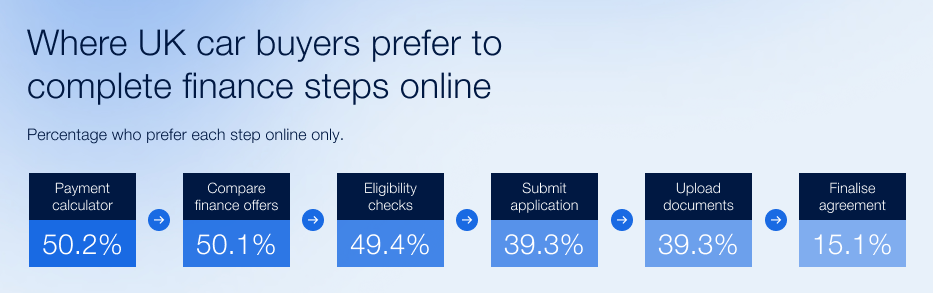
This preference pattern is reflected in how finance is currently arranged in practice. Among UK respondents who financed their most recent vehicle, 21% arranged finance entirely online, the highest of any market surveyed, while 33% used a mix of online and offline steps, also the most of any market. At the same time, 40% arranged finance entirely offline – the lowest figure of any market surveyed.
When asked what matters most within digital finance tools, UK respondents consistently prioritised affordability visibility, transparency and simplicity. The highest priorities were:
This presents a clear opportunity within the UK automotive customer journey. Consumers show significant interest in affordability visibility and digital finance tools, yet many still rely on partially offline finance journeys.
Concerns around digital car finance also remain closely tied to trust and reassurance. Two in five (38.6%) cited concerns around data security, privacy and fraud, while a third (33.3%) worry about making mistakes and 33.2% preferred in-person reassurance.
When asked where they prefer to arrange finance online, dealer and retailer websites were the most popular choice at 25.8%, followed by finance provider or bank websites (20.1%), and manufacturer websites (17%).
For organisations investing in digital finance tools, the findings show that consumers want finance journeys that combine affordability visibility and digital convenience with transparency, reassurance and seamless movement between online and dealership steps.
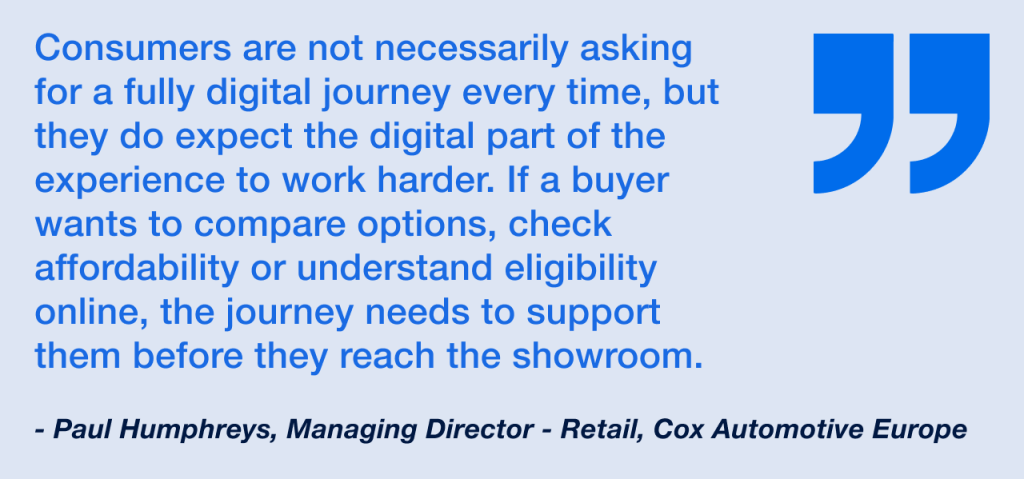
The most valued feature throughout the vehicle acquisition process in the UK is the ability to understand which vehicles they can afford based on a monthly cost (50.8%).
Even in a market where more than half of respondents paid for their last vehicle in full (51.5%), monthly payment visibility remains a primary way consumers assess affordability within the car finance market.
However, wider findings suggest friction in understanding affordability. Earlier in this report, it was identified that 28.4% of respondents cited unclear total cost information as a key frustration in the research journey, while transparency around fees, interest rates and total cost of ownership repeatedly emerged as a key trust driver within the finance process.
However, wider findings suggest friction in understanding affordability. Earlier in this report, it was identified that 28.4% of respondents cited unclear total cost information as a key frustration in the research journey, while transparency around fees, interest rates and total cost of ownership repeatedly emerged as a key trust driver within the finance process.
It’s clear then, that UK consumers are looking for clearer understanding of what monthly payments actually involve, and whether they realistically fit within their budget. Monthly affordability attracts attention, but clear visibility of total cost, fees and interest rates is critical in building confidence.
This becomes more important when considering that, despite elevated levels of finance awareness and confidence, 47.8% of UK respondents have never used finance to purchase a vehicle.
Among those who would not consider finance or a loan, 56.2% said they prefer to avoid debt and pay using savings, while 52.5% want to own the vehicle outright from the beginning. Concerns around high interest rates and hidden fees (41.1%), and overall finance complexity (8.7%) also remain influential in UK car finance behaviour. These findings reinforce the wider role affordability, ownership and transparency continue to play within UK car finance behaviour.
Overall, the findings reveal a UK automotive market that is digitally confident and comfortable engaging with finance. Yet, affordability, transparency, ownership and trust shape conversion.
1. UK consumers demonstrate considerable levels of financial confidence and awareness of finance products. However, finance transparency and debt concerns remain prominent.
2. Omnichannel car buying behaviour is firmly established, with UK consumers expecting connected experiences between digital research, finance exploration and dealership interaction.
3. Monthly payments are a primary affordability lens within the UK car finance market, increasing the importance of cost breakdowns and visible finance tools throughout the automotive customer journey.
4. Digital engagement is strongest during research, comparison and affordability assessment stages, while many consumers still prefer in-person reassurance during final commitment stages.
5. Ownership remains a major influence on finance behaviour, with products that preserve a route to ownership generating greater appeal and future consideration than those focused purely on vehicle access.
European car buying trends vary across the UK, Germany, France, Spain and Italy. Respondents across all five markets value clear affordability information, transparent finance communication and connected buying experiences, but how those expectations translate into behaviour differs by country.
The UK and Germany demonstrate the strongest evidence of omnichannel car buying behaviour and more digitally led purchase journeys, while France shows more traditional purchasing and finance behaviours. Italy and Spain, meanwhile, display comparatively lower financial confidence, despite higher usage rates, alongside a greater preference for dealership-led buying and finance experiences.
These pan-European car buyer insights are particularly important for OEMs and finance providers operating across multiple regions. Consumer behaviour differences mean that how finance transparency, digital tools, affordability and dealership involvement are embedded into the customer experience requires a localised approach.
This section examines how consumers across Germany, France, Italy and Spain buy vehicles, use car finance, move through the automotive customer journey, and compare to the UK market. This analysis aims to highlight where car finance engagement is strongest, which markets show the highest levels of digital adoption, where friction remains and where commercial opportunities emerge.
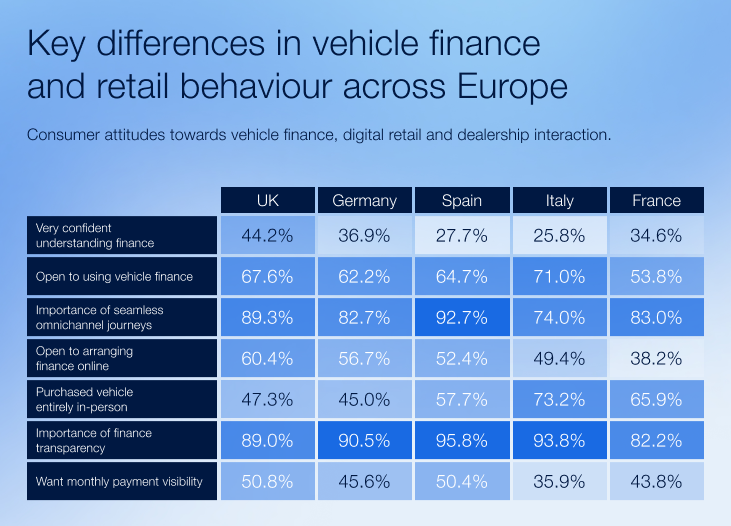
Car purchase behaviour takes different forms across Europe. While all five markets demonstrate omnichannel car buying behaviour and expectations, the balance between digital engagement and dealership involvement differs considerably between markets.
The UK and Germany demonstrate the strongest levels of digital vehicle research and mixed-channel purchasing behaviour, while France, Italy and Spain appear more dealership-led throughout the purchase process.
Omnichannel automotive customer journeys: The UK vs. Spain, France, Italy and Germany
Demand for a connected retail experience was further highlighted when respondents were presented with a scenario where research, finance exploration and dealership interactions work together as part of one joined-up journey, with appeal exceeding 83% in every market:
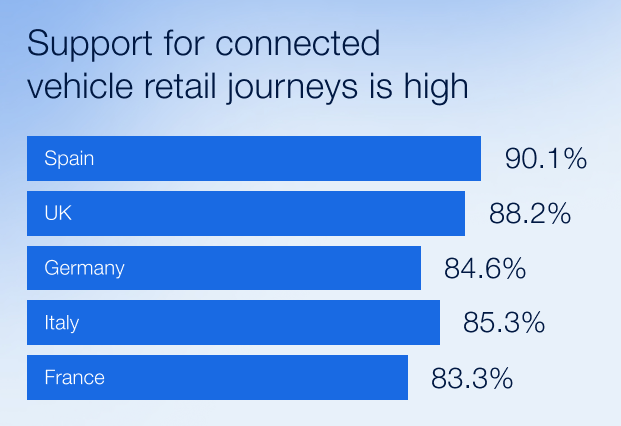
However, the data presents key differences in which aspects consumers value the most within the omnichannel journey.
As established, the UK recorded extensive omnichannel expectations throughout the vehicle buying process, yet Spain demonstrated similarly strong demand. 42.7% of Spanish respondents value the ability to start the journey online and complete it offline, while two in five (40.7%) wanted to carry finance pre-approval into a dealership, and a further 43.6% prioritised consistent pricing across channels.
That demand for continuity throughout the purchase process was reflected in the German market. 35% of German respondents valued consistent pricing between online and offline channels, while 34.2% prioritised switching between channels without repeating information and 34% value personalised offers that continue throughout the journey.
By contrast, France and Italy displayed lower emphasis on connected omnichannel experiences overall, although almost a quarter of respondents in both markets still prioritised the ability to move seamlessly between online and dealership stages, 23.9% and 22.7% respectively. This points to the need for more supported journeys in these countries, where digital tools help consumers build understanding and confidence alongside dealer, retailer and lender conversations.
This reflects a European market that largely expects connected automotive purchase journeys, with some markets prioritising it more than others. Across all markets, pricing consistency, personalised offers and reducing administration were among the most valuable features when researching and purchasing a vehicle.
Vehicle research and purchasing behaviour across Europe
Moving from expectations to reality, the UK and Germany demonstrated the strongest levels of omnichannel research and purchasing behaviour across all markets surveyed.
Vehicle research behaviour in Europe
The UK recorded some of the highest levels of digital-first car research behaviour across several channels, while still maintaining dealership involvement.
Germany displayed a similar digitally engaged research approach, particularly through specialist automotive platforms:
Meanwhile, France, Italy and Spain showed a greater preference for in-person vehicle research. Italy recorded the most significant level of dealership research behaviour overall, with 68.1% visiting dealerships during vehicle research. Spain followed closely at 66.6%, while France recorded 66.3%.
France showed a more traditional research pattern, with lower use of several digital channels:
Vehicle purchasing behaviour in Europe
Vehicle buying behaviour further reinforces the divide between digitally engaged and dealership-led purchase journeys across Europe.
In the UK, 27.5% of respondents completed their most recent purchase through a mix of online and in-person steps, the highest proportion overall, followed by Germany (24.1%). Germany recorded the most advanced level of fully online vehicle purchasing at 28.7%, followed by the UK at 23.2%.
Spain also showed relatively strong mixed-channel purchasing behaviour, despite being more dealership-led overall. Nearly one in four (24.1%) respondents combined online and offline steps, and 17.3% completed the purchase fully online.
By contrast, Italy demonstrated the strongest in-person car buying preference, with 73.2% completing their most recent vehicle purchase entirely in person, while only 10.3% purchased online overall, the lowest of all markets. France also showed comparatively low mixed-channel behaviour, with just 10.9% combining online and in-person stages throughout the purchase process.
The importance of dealerships in the car research and buying journey remains critical. Even in digitally engaged markets such as the UK and Germany, consumers continue to combine online research with in-person dealership interaction.
Purchase journey friction and complexity
Despite appetite for connected buying journeys across Europe, respondents experience friction throughout the purchase process today.
The UK recorded some of the most notable levels of purchase journey complexity overall. Nearly two in five (38.8%) cited overwhelming choice as a major frustration, while 26.1% described the research process as too time-consuming or complex. A further 20.7% said they were frustrated by having to repeat personal or financial information across online and offline channels – all the highest figures of any market surveyed.
Germany also showed signs of friction with mixed-channel journeys, particularly around inconsistent information across online and in-person channels (19.7%), the highest level recorded across all five markets.
Spain presented a slightly different picture. Despite demonstrating some of the strongest appetite for connected and digitally integrated purchase journeys, they also recorded the highest levels of frustration around pricing transparency and finance comparison:
By contrast, France and Italy reported comparatively lower levels of friction around digital integration and purchase complexity. France recorded the lowest proportion of respondents describing research as too time-consuming or complex (13.9%), while Italy recorded the lowest frustration around overwhelming choice (14.5%).
These findings align with the wider behavioural trends seen across France and Italy, where consumers demonstrate lower levels of digital engagement and weaker omnichannel expectations than those observed in the UK, Germany or Spain.
In practice, consumers across Europe expect connected, transparent and flexible purchase journeys. However, the barriers preventing those experiences range from information overload and channel inconsistency in the UK and Germany, to pricing clarity and finance comparison challenges in Spain.
Finance maturity, car ownership and financial confidence across Europe
Earlier findings showed clear differences in how consumers across Europe research and purchase vehicles. Those differences also extend into how consumers engage with vehicle finance, understand finance products, approach vehicle ownership and fund their vehicles.
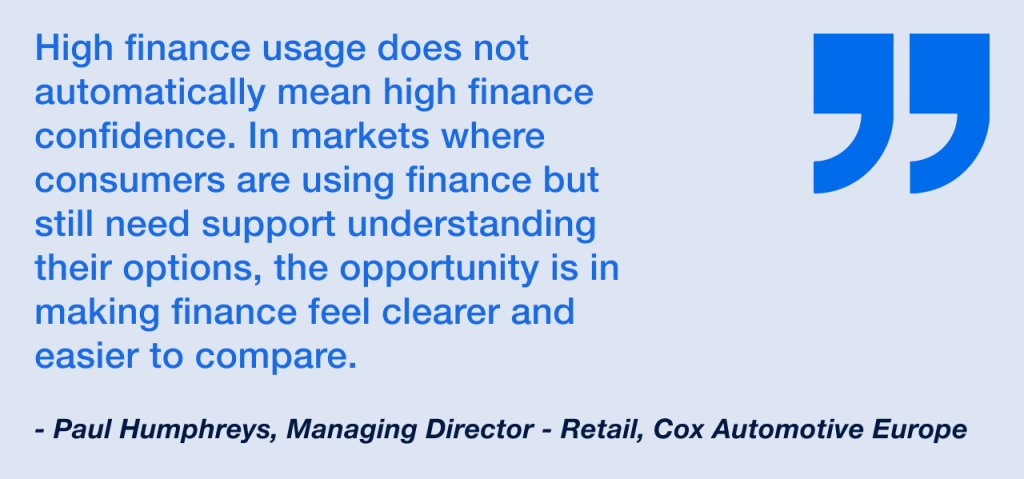
The UK and Germany demonstrate the most substantial levels of finance confidence and product awareness, while Spain and Italy show mature finance usage but lower confidence in finance understanding. France, meanwhile, shows a more selective relationship with vehicle finance, with lower usage and consideration than other markets surveyed.
Together, the findings highlight that finance maturity across Europe is shaped not only by finance usage, but also by confidence, product familiarity and ownership expectations.
European car ownership data and openness towards vehicle finance and loans
Car ownership data reveals significant differences in how consumers fund vehicles, particularly when comparing outright purchase behaviour with vehicle loan usage and openness to car finance products.
Germany (51.8%) and the UK (51.5%) recorded the highest levels of outright vehicle purchasing, closely followed by France at 49.7%. However, those markets show different levels of vehicle loan engagement.
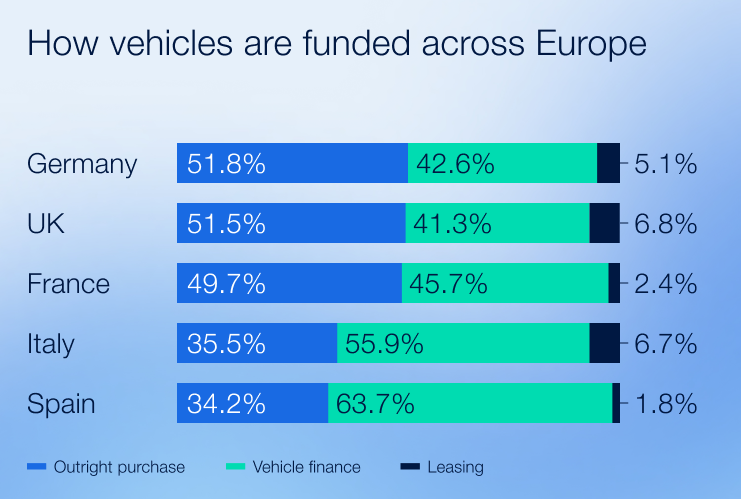
The UK combines strong outright ownership behaviour with extensive levels of confidence, product awareness and future openness to vehicle loans. France, by contrast, shows a more traditional funding profile, with outright purchase still playing a significant role alongside moderate vehicle finance usage.
Only 34.2% of Spanish respondents and 35.5% of Italian respondents purchased their most recent vehicle outright, while demonstrating the highest use of vehicle finance and loans across all markets.
Openness towards future vehicle finance use follows a similar pattern. Italy recorded the highest openness towards arranging vehicle finance at 71%, followed by the UK (67.6%), Spain (64.7%), Germany (62.2%) and France (53.8%).
Leasing was the least commonly used vehicle funding model overall. The UK recorded the strongest usage at 6.8%, closely followed by Italy at 6.7%. Germany recorded 5.1%, while France (2.4%) and Spain (1.8%) showed comparatively limited adoption.
Resistance to leasing suggests that outright ownership is an important influence across European vehicle funding behaviour. Consumers want to own their vehicles, but how they access ownership differs.
Car finance understanding and consumer confidence across Europe
Finance confidence varies considerably across Europe, particularly in how consumers understand vehicle finance and loan products, and different payment models.
The UK recorded the highest levels of financial confidence overall, with 44.2% of respondents describing themselves as ‘very confident’ in understanding the different ways to pay for a vehicle. Germany followed at 36.9%, ahead of France at 34.6%.
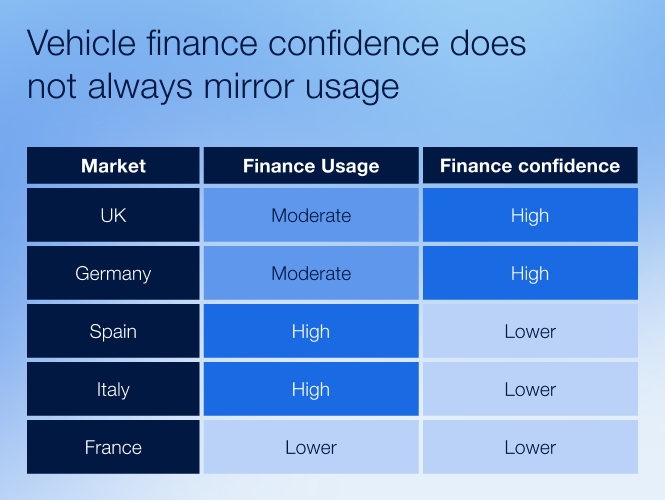
Despite demonstrating stronger finance usage in practice, Italy and Spain displayed lower confidence in automotive finance products. Only 27.7% of Spanish respondents described themselves as ‘very confident’, followed by Italy at 25.8%. In addition, 13.5% of Italian respondents and 16.3% of Spanish respondents said they find vehicle finance confusing and often need support deciding which option is best for them, substantially higher than the UK (5.8%) and Germany (6.4%).
These findings reinforce that finance maturity is shaped not just by finance usage, but by confidence, understanding and product familiarity. While Spain and Italy demonstrate considerable finance penetration, UK and German respondents appear more confident navigating vehicle finance products and payment models.
Awareness of vehicle finance products is mature in all five European markets surveyed. However, important differences emerge when comparing product familiarity, appeal and avoidance behaviour.
The UK was the most aware of major finance products, while Germany also demonstrated particularly high familiarity with PCP (or balloon payment) at 96.1%, and leasing at 93.7%. By contrast, awareness gaps were more visible in Southern European markets. PCP (balloon payment) awareness fell to 83.3% in Spain and 73.2% in Italy.
Looking at which finance products hold the strongest appeal, dealer or retailer finance products performed strongly across most markets surveyed, emerging as the most appealing option in Spain (69.4%), the UK (65.1%) and Germany (60.6%).
Italy differed slightly with Hire Purchase recording the strongest appeal overall at 73.7%, ahead of dealer or retailer finance products at 70.7%. France also showed a different pattern, with bank or personal loans recording the strongest appeal at 65%, ahead of PCP (59.3%) and dealer or retailer finance products (58.5%). PCP appeal remained relatively balanced across all markets, led by Spain (61.8%) and the UK (61.4%).
Leasing generated weaker appeal across Europe. Germany recorded the lowest leasing appeal at 48.6%, while France was the market most likely to actively avoid leasing at 46.8%, followed by Spain (44.7%) and Germany (43.8%). Even in the UK, where leasing usage was highest (6.8%), it still generated a relatively high avoidance rate at 39.9%.
France showed the most cautious response to several finance products. French respondents recorded the strongest avoidance levels across leasing (46.8%), Hire Purchase (46%), PCP (balloon payment) (42.2%) and dealer or retailer finance products (33.5%).
Together, the findings reinforce what earlier finance usage trends already suggested: products linked to ownership generated stronger appeal across all five markets, while France appears to be the most cautious market when evaluating vehicle finance products, indicating the need for clear and transparent communications.
Car finance trust and transparency: How European consumer perceptions compare
Across Europe, trust in car finance is shaped by both provider reputation and the way finance information is presented to consumers. While confidence, understanding and preferred finance routes differ by market, the data shows that credibility and clarity remain important throughout the vehicle finance journey.
Trust, transparency and finance decision making in Europe
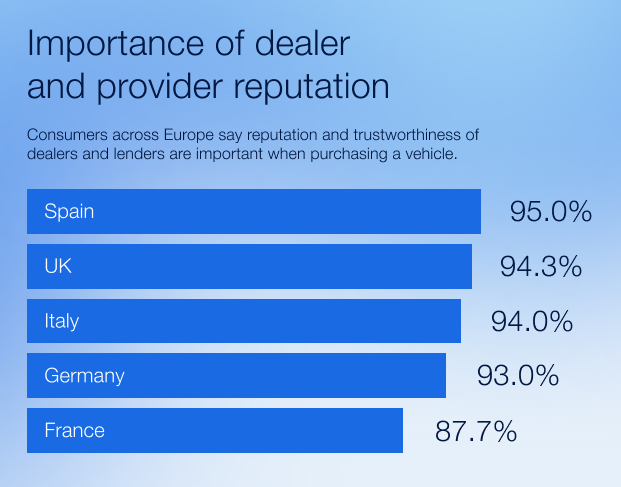
A similar pattern emerged when consumers were asked how important the reputation and trustworthiness of the dealer or finance provider was when purchasing a vehicle:
The consistency of these results shows that credibility and clarity matter across the UK and Europe, even where consumer confidence, understanding and finance behaviour differ. For dealers, OEMs and finance providers, this highlights how critical reputation, clarity and reassurance is in how consumers assess their vehicle funding options.
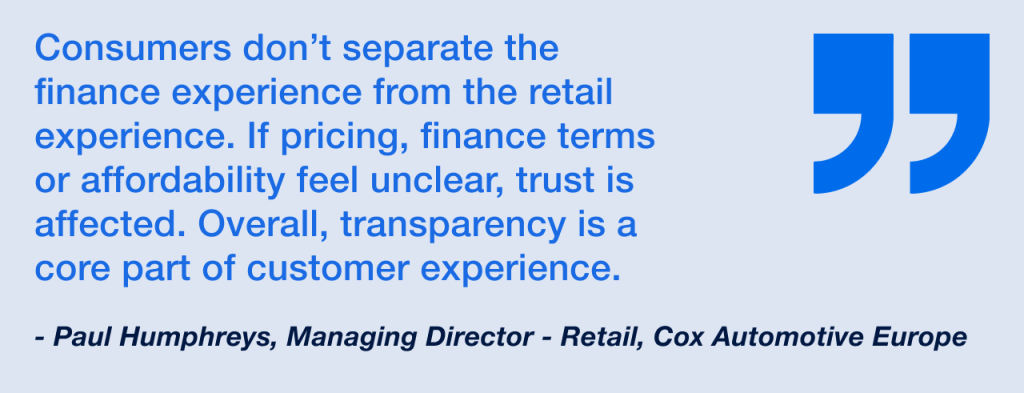
Despite trust and transparency being critical to all five markets, respondents report transparency-related friction within the finance journey.
Spain recorded some of the highest levels of transparency-related friction overall:
Similarly, Italy showed the most frustration around limited finance provider choice, with 20.2% saying too few finance options or providers were presented to them.
Germany, by contrast, recorded the lowest frustration around finance transparency issues, with only 14.6% citing a lack of clarity in finance terms as a concern. Combined with earlier findings around strong financial confidence, high product awareness and digitally engaged research behaviour, German consumers appear comparatively comfortable navigating finance products and comparing finance options, despite also recording high levels of outright vehicle purchasing.
France reported fewer transparency-related frustrations overall, including the lowest frustration around understanding eligibility or affordability checks (10.2%). However, this should be viewed alongside France’s lower finance engagement overall. In markets where fewer consumers are actively engaging with finance, these issues may be less visible as a frustration, but remain important for building trust, familiarity and confidence early in the journey.
The vehicle finance providers European consumers trust most
The types of vehicle finance providers consumers are most likely to consider differ significantly across Europe, revealing important differences in how trust in vehicle finance is formed.
Retail banks emerged as the preferred finance provider type overall, particularly in Spain, Germany and the UK. More than half of Spanish respondents (55.9%) were most likely to consider retail banks over any other provider type. Germany showed the same trend at 43.2%, and the UK at 36.5%.
Germany and the UK also recorded some of the strongest consideration towards automotive finance brands at 15.5%, and 15.3% respectively, suggesting automotive finance brands play a particularly important role within those markets.
Italy, meanwhile, showed significantly higher openness towards consumer finance providers (25.4%) than any other market surveyed. By contrast, Germany recorded almost no preference for these providers (0.1%).
Trust in dealer arranged finance also varies. Germany (9.2%) and Spain (9.8%) recorded the strongest consideration towards dealerships and online vehicle finance platforms, while Italy recorded the lowest at just 2.3%.
Despite elevated levels of finance awareness across Europe, many consumers still avoid vehicle finance products. However, resistance is more closely linked to ownership preferences, debt aversion and transparency concerns than a lack of understanding.
Across all five markets surveyed, the most common reason for avoiding finance was a preference to avoid debt:
Ownership preferences also remain influential across every market. More than half of UK respondents avoiding finance (52.5%) said they want to fully own the vehicle immediately, while this was also cited by respondents in Germany (43%), France (35.6%), Italy (33.3%) and Spain (28.4%). This reinforces wider findings throughout the report that routes to ownership remain an important factor in how consumers evaluate finance products.
Transparency and affordability concerns are also significant barriers to finance adoption. 41.1% of UK respondents avoiding finance cited concerns around high interest rates or hidden fees, followed by Spain (38.6%), France (33.8%), Germany (29.3%) and Italy (28.2%).
Distrust of lenders and finance providers also emerged as a consistent concern, particularly in Spain (20.5%) and Italy (19%). Germany recorded the lowest levels of distrust at 12.6%, further supporting the wider pattern of comparatively higher financial confidence and lower finance friction within the German market.
Previous finance experiences also influenced reluctance towards finance in some markets. Spain again recorded the highest levels, with 14.8% saying that past experiences affected their willingness to use finance again, followed by Germany at 13% and Italy at 10.6%.
Knowledge gaps and process complexity appear less influential across the board, although they’re more prominent in Italy and the UK. 8.8% of Italian respondents said they did not know enough about how finance works, while 14.7% of UK respondents said finance processes felt too complicated or time-consuming.
Overall, finance avoidance across Europe is rarely driven by a single issue. Ownership expectations, debt attitudes, transparency concerns, provider trust and previous finance experiences all shape how consumers evaluate vehicle finance products.
Digital finance adoption across Europe is shaped by how comfortable consumers feel using online tools for research, comparison and affordability checks, and where they still want support, reassurance or in-person interaction during key decision points.
These differences are closely linked to finance confidence, digital maturity and the role dealerships play within each market. In countries where finance understanding is lower or dealership relationships remain more central, digital tools may need to focus more strongly on guidance and reassurance.
Consumer attitudes towards arranging finance entirely online varied considerably across markets.
The UK (60.4%) and Germany (56.7%) recorded the strongest positive sentiment overall, followed by Spain (52.4%) and Italy (49.4%). France showed the highest negative reaction at 27.9%, yet 38.2% still reacted positively.
In practice, however, adoption rates remain lower, with clear differences emerging between markets. The UK recorded the highest levels of fully digital finance behaviour at 21%, followed by Germany at 18.5%, and France at 12.2%. Spain and Italy remained significantly more dealership-led with more than 60% of respondents in both markets arranging finance entirely at the dealership, while fully online finance usage remained below 10%.
The contrast between positive perceptions of fully online finance journeys and lower adoption rates highlights the need for helpful and easy-to-use tools that provide reassurance along the way.
Similar trends appeared when looking at how many respondents used a mix of online and offline steps to arrange the finance of their most recent vehicle: UK (33%), Germany (22.2%), Italy (15%), Spain (12.9%) and France (6.6%).
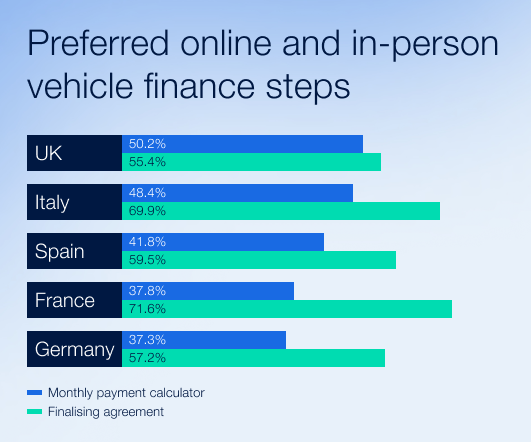
All markets showed a clear preference regarding the stages they’d rather complete online. Comparing finance offers and checking eligibility or affordability were popular for all respondents, but using a calculator to see which cars they can afford based on a monthly payment was the most popular choice for all markets:
Finalising the agreement, however, was the most popular step to complete in-person:
Age also appears to influence digital finance behaviour. Across the five markets, younger respondents were more likely to react positively to online finance and use affordability tools, while older respondents who were more likely to favour in-person purchase journeys. However, preference for finalising finance in person remained consistent regardless of age, reinforcing that digital tools are most valuable when they support, rather than replace, reassurance during commitment stages.
Online affordability tools and monthly payment behaviour in Europe
As established, affordability visibility is one of the biggest drivers of digital finance engagement across all markets.
This is shown in the percentage of respondents who had used an online finance calculator and found it helpful; UK (45.6%), Spain (40.5%), Germany (33.6%), Italy (27.9%) and France (26.3%).
Consumers across every market also showed a preference for completing affordability-related tasks online. Half of UK respondents (50.2%) want to use online monthly payment calculators, followed by Italy (48.4%), Spain (41.8%), France (37.8%) and Germany (37.3%), while comparing finance offers online generated particularly strong demand in the UK (50.1%) and Italy (47.9%). Checking affordability or eligibility online also ranked highly, especially in Italy (43.3%) and Spain (41.8%).
The findings reinforce wider themes around monthly payment sensitivity and affordability transparency across all five markets. Respondents consistently prioritised:
Looking at the potential benefits of arranging vehicle finance online, convenience, speed and flexibility were key drivers.
Spain recorded the highest proportion of respondents citing convenience and time savings as a key benefit at 60%, closely followed by the UK at 59.3%, Germany (53.8%), Italy (50.3%) and France (42.6%). Faster approval processes also ranked highly in the UK (54%), Spain (49.4%) and Germany (42.8%).
Where consumers would prefer to arrange finance online further reinforces the continued importance of trusted retail environments – both online and offline – as dealer and retailer websites generated the strongest preference across all countries:
Finance provider or banking websites were the second most preferred option across all markets, while Italy and Germany showed comparatively stronger interest in specialist finance comparison platforms at 13.1% and 12.7% respectively.
Across Europe, consumers appear most receptive to digital finance experiences when convenience is combined with reassurance, transparency and familiar retail environments. While appetite for online finance is present, trust remains closely linked to provider credibility, visible support and confidence throughout the finance journey, rather than digital functionality alone.
Five car buying trends shaping the European market in 2026
1. Consumers across all five markets value connected vehicle buying journeys that combine online research, affordability tools and dealership interaction. However, the level of digital integration expected throughout the journey varies significantly between markets.
2. Digital engagement does not replace dealership involvement. Even in digitally evolved markets such as the UK and Germany, dealerships remain central throughout vehicle research, finance discussions and final purchase decisions.
3. Finance maturity cannot be measured by usage alone. Spain and Italy show high levels of vehicle finance usage, yet lower confidence in understanding finance products. By contrast, the UK and Germany show stronger finance confidence, product awareness and digital finance maturity despite elevated levels of outright vehicle purchasing.
4. Trust, transparency and affordability visibility shape finance behaviour across Europe. Clear finance terminology, transparent pricing, monthly payment visibility and trusted providers are central to consumer decision-making.
5. European automotive retail strategies need local market adaptation. Expectations around finance journeys, digital retail, ownership preferences, provider trust and affordability differ significantly between countries.
European automotive retail strategy in 2026 depends on adapting finance transparency, digital retail maturity and affordability presentation to local market behaviour. While connected retail expectations are consistent across Europe, trust, finance confidence and dealership involvement vary significantly between the UK, Germany, France, Spain and Italy.
This report shows that while key themes like transparency and affordability visibility run through all markets surveyed, digital and finance maturity varies. The UK and Germany demonstrate significant omnichannel and digital finance behaviour, while also retaining strong outright ownership preferences. Spain and Italy combine higher levels of vehicle finance usage with stronger dealership involvement and the greater demand for reassurance throughout the journey. France, meanwhile, demonstrates a more traditional and supported purchase profile, although a meaningful proportion of consumers remain open to connected retail and finance experiences.
These findings create important strategic implications for OEMs and lenders operating across multiple markets, as well as UK retailers looking to improve customer experience and finance engagement domestically.
Strategic themes shaping European automotive retail strategy
1. Connected automotive retail strategies must adapt to local market maturity
Digital automotive retail maturity across Europe is uneven, creating important implications for how connected retail and finance journeys are developed in each market.
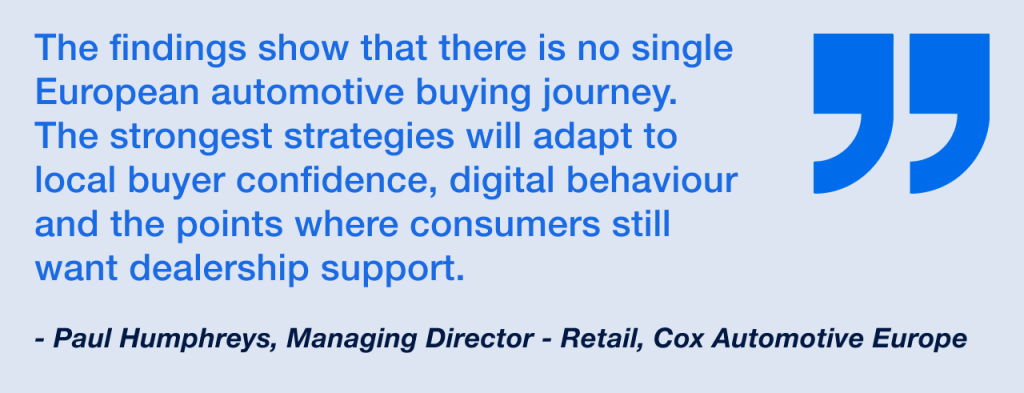
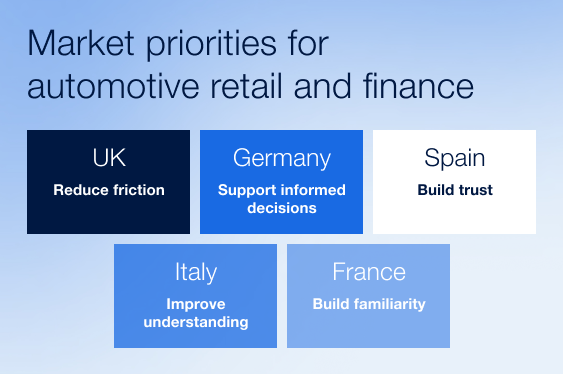
Respondents in the UK and Germany are financially confident and comfortable with finance, researching vehicles digitally and moving between online and dealership stages throughout the purchase process. The priority in these markets should therefore be providing a clear, friction-less omnichannel journey that helps consumers make informed decisions and compare options effectively.
Spain and Italy, however, show an appetite for connected retail experiences and finance products, yet remain less confident and more dealership-led. These markets would benefit from clear explanations of finance routes and terms, total cost visibility at the forefront and the ability to carry the journey into dealerships after completing online steps.
In France, where finance engagement and omnichannel adoption is lower and more traditional purchasing behaviour is more prominent the focus should be on building familiarity and trust with education.
Trust, transparency and finance confidence consistently emerged as major drivers of vehicle finance behaviour across all five markets surveyed.
Consumers expect:
These findings indicate that finance conversion could be improved if retail strategies focus on building trust through transparent communication and reassurance. Consumers need to understand what they are signing up to, how options compare and whether the provider can be trusted before they are willing to progress.
What this means for the industry:
Finance communication should be treated as a core part of the customer experience. Putting transparent cost breakdowns at the forefront, using consistent terminology, simplifying explanations and making provider credibility visible early on can help build trust and reduce uncertainty. Those who prioritise transparency and trust in their retail strategies could see stronger finance engagement across all markets.
3. Monthly payments are shaping automotive retail strategy
Across every market surveyed, monthly payment visibility strongly influences how consumers assess vehicle affordability. But this isn’t just a finance consideration. It affects how buyers search, compare and shortlist vehicles.
Respondents consistently prioritised:
These findings suggest consumers aren’t evaluating vehicles by headline price alone. Instead, monthly affordability is becoming part of the vehicle discovery and stock comparison stages and informing the overall purchase consideration. If buyers want to understand which vehicles fit their monthly budget early in the journey, then monthly payment visibility needs to shape how vehicles are presented before a finance application begins.
What this means for the industry:
Automotive retail strategies should treat affordability as part of vehicle merchandising, not just at the finance processing stage of the journey. Monthly payment visibility should support how vehicles are listed, filtered, compared and shortlisted, with realistic estimations based on real-life circumstances.
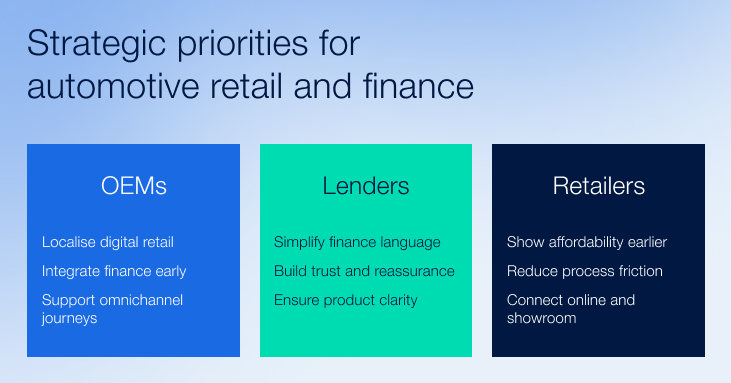
European car buyer trends in 2026 show key differences in how consumers across the UK, Germany, Spain, Italy and France approach vehicle purchasing, car finance and omnichannel retail journeys. Across all five markets, consumers value digital research, clear affordability information and dealership interaction working together as one connected experience.
Finance confidence, trust, affordability and ownership preferences shape how consumers engage with automotive retail across Europe. Yet, the balance between digital engagement, finance maturity and dealership reliance differs significantly between markets.
This creates a major challenge for OEMs and lenders operating across multiple regions, because strategies that perform well in one market may not translate directly into another. At the same time, several expectations remain the same across all five markets surveyed.
Respondents in all markets want:
For UK retailers, the findings highlight how British consumer expectations, finance behaviours and digital engagement create opportunities to improve conversion, transparency and customer experience within the domestic market.
The findings also show that digital engagement doesn’t remove the importance of dealerships. Even in markets where digital finance maturity is strongest, such as the UK and Germany, many consumers still prefer in-person reassurance during the final commitment stages.
Finally, this report highlights the important role of embedded finance within automotive retail. Respondents expect finance tools, affordability guidance and payment comparison to support vehicle discovery, rather than added into the process later down the line.
The opportunity, therefore, isn’t simply digitalising vehicle retail entirely, but reducing friction between digital and in-person stages to provide options for consumers, while improving trust, transparency and affordability understanding throughout the process.
For the industry, competitive advantage lies in how effectively finance, commerce and customer experience operate together across connected retail ecosystems.
Codeweavers helps automotive retailers, OEMs and lenders create connected retail and finance journeys through integrated digital retail technology.
Explore more European retail and finance insights on the Codeweavers blog.